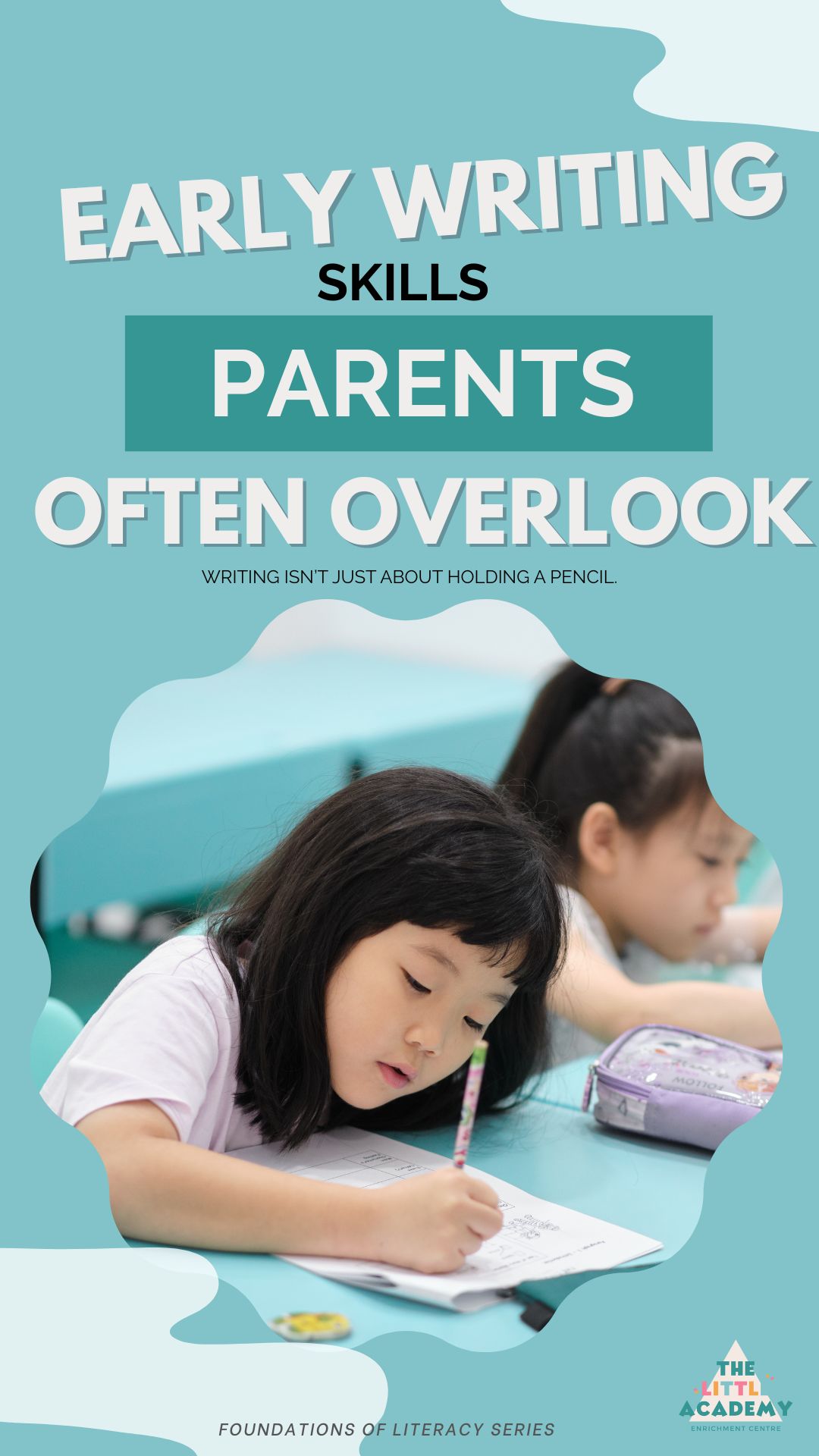
Writing isn’t just about holding a pencil.
When we think about writing, many parents picture neat handwriting, correct spelling, and full sentences.
But strong writing actually begins long before children can write words on a page.
Research in child development and literacy shows that writing is built on a combination of thinking, language, motor skills, and confidence, not just pencil control.
What parents need to know
Strong writing foundations start early and include much more than handwriting. These foundations involve:
-
Fine motor strength (to control the pencil)
-
Phonemic awareness (hearing and identifying sounds for spelling)
-
Sentence awareness (knowing how ideas are formed into sentences)
-
Vocabulary development
-
Confidence to express ideas
Educational psychologist Lev Vygotsky emphasised that children develop writing through spoken language and interaction first. When children talk, explain, and tell stories, they are already practising the skills needed for writing.
Similarly, Jean Piaget highlighted that children learn through exploration and experimentation. Early writing attempts even when they look messy or incorrect are signs that children are thinking and learning.
Signs of writing readiness parents may overlook 👀
Many parents worry when their child’s writing doesn’t “look right” yet. However, research by literacy experts Marie Clay and Emilia Ferreiro shows that children go through clear developmental stages in writing.
These are positive signs of readiness, not mistakes:
✔ Drawing pictures with details
✔ Attempting invented spelling (e.g. “frn” for friend)
✔ Telling stories in sequence
✔ Copying simple words
✔ Using finger spaces in early writing
Invented spelling, in particular, is powerful. Marie Clay found that when children spell words based on the sounds they hear, they are actively learning how language works — even before they can spell conventionally.
Why neat handwriting shouldn’t come first
Neat handwriting requires fine motor strength and control, which take time to develop. Occupational therapy research shows that children build these skills best through play-based activities, such as drawing, colouring, cutting, and building.
Forcing neat writing too early can:
-
Increase frustration
-
Reduce confidence
-
Make writing feel stressful instead of meaningful
Writing should first be about ideas and expression, not perfection.
How parents can support writing at home 🏡
Here are simple, effective ways to nurture strong writing foundations:
🖍 Provide a variety of writing tools
Markers, crayons, chalk, whiteboards — these build hand strength and interest.
📔 Encourage drawing and journaling routines
Let children draw and talk about their pictures. This connects ideas to expression.
🔤 Let children sound out words
Allow invented spelling instead of correcting immediately. This builds phonemic awareness and confidence.
🗣 Build oral storytelling skills
Ask questions like:
-
“What happened first?”
-
“Then what?”
-
“How did you feel?”
🌟 Celebrate effort, not just accuracy
Confidence is key. A child who feels safe to try will learn faster than one who fears mistakes.
Writing is not a single skill but a developmental journey.
When we focus on foundations such as language, thinking, motor skills, and confidence, we give children the tools they need to become capable and confident writers in the long run.
So if your child is drawing, spelling creatively, or telling imaginative stories, they are already on the right path.
✨ These are not mistakes. They are milestones. ✨